How did our school of Russian language and literature begin?
Hello! I’m Elizaveta Zakharova, head of the School.
In 2013 I taught my very first literature lesson at a school.
Today, with a bachelor’s degree from Saint Petersburg State University, a master’s and postgraduate studies at Moscow State University and a PhD in Philology behind me, I can say how endlessly grateful I am that academic work and teaching have always complemented each other. A scientific approach is the foundation of the School’s lessons, courses and creative workbooks.


2022 was a time of change for many people, and my family was no exception. Moving abroad and widening our outer and inner boundaries showed that many families face the same dilemma: “our own culture vs adapting to a new reality”.

How can we nurture and sustain
a love of the native Word?

For children and adults alike, keeping a love of their native language and literature has become a task both in Russia and far beyond it.
The School’s aim is to help people fall in love with Russian through culture and literature: we study Russian literature from the 12th century to the best writing of today. Developing speech, communication skills and personality is at the heart of the School’s approach.
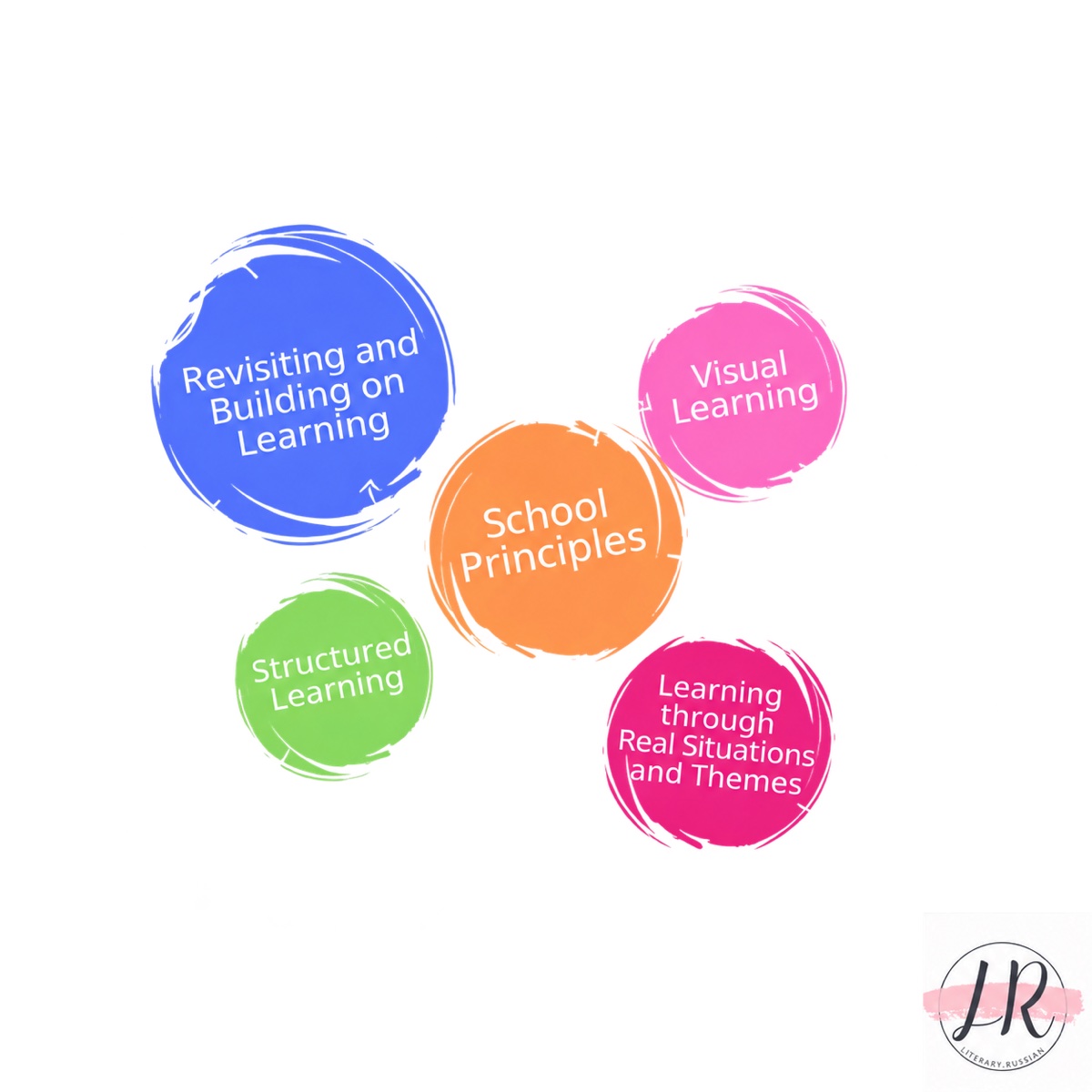
Principles
Methods
Tell me your method and I’ll tell you who you are. Teachers could greet each other this way, because it is the method that sets the course of a lesson and the shore those lessons will eventually reach.
Our school’s core method is the communicative one. We use it in lessons with both Russian-speaking and international students.
- We keep the use of a go-between language (Serbian, English and others) to a minimum
- Grammar and vocabulary are learnt for real communication, not just to tick a box
- No cramming of rules and word lists: practical exercises make the skill automatic
- As much practice in class as possible
- A personal approach: the programme adapts to each student’s goals
- Homework is chosen to suit in amount and format. Consolidation matters, but we take each student’s needs into account.
No one has put it about teaching better than the historian Vasily Klyuchevsky:
“To be a good teacher, you must love what you teach and love those you teach.”
A scientific approach
A scientific approach means we never act at random: we know why we choose one lesson format over another.
The format of a lesson depends on its aims and tasks, and on the type of lesson.
A practising teacher guided by a sound methodological compass knows many ideas and techniques and picks the ones that suit a particular group or student.
One thing never changes, the golden rule of our lessons: keep, support and multiply a good mood.
“The surest sign of wisdom is a constant cheerfulness.” — Michel de Montaigne
The motto of our lessons, courses and study materials:
“For family use”.
Families are who we work for.
With love for our work and our students
________
Elizaveta Zakharova
Stay in touch
Send us a request and we’ll get back to you and help you choose a programme